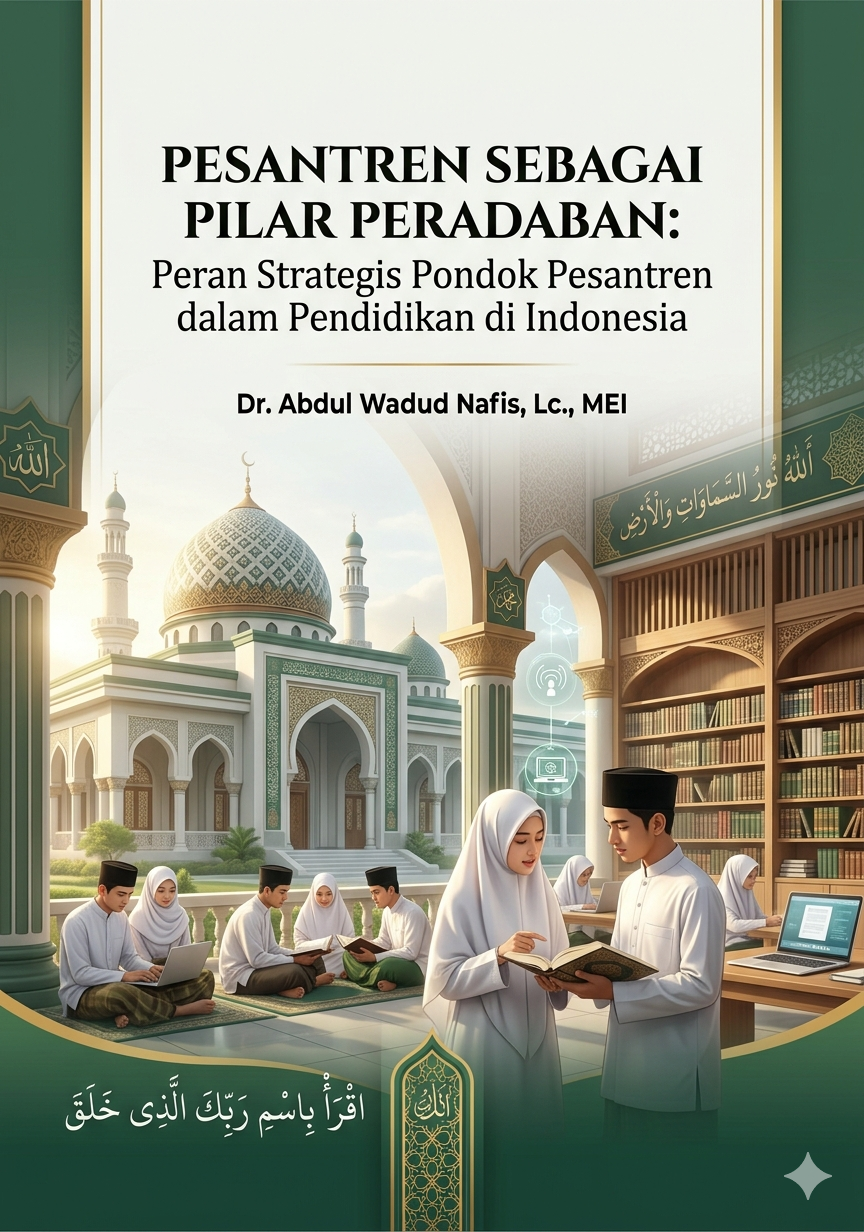
Pesantren as a Pillar of Civilization: The Strategic Role of Islamic Boarding Schools in Education in Indonesia
Dr. Abdul Wadud Nafis, Lc., MEI
Islamic boarding schools, known as pesantren, are among the oldest educational institutions in Indonesia and have made an enormous contribution to the development of the nation’s civilization. Since the early spread of Islam in the archipelago, pesantren have served as centers of religious learning, moral guidance, and human resource development. Their existence functions not only as religious educational institutions, but also as centers of social transformation that shape the character of younger generations.
In the context of national education, pesantren hold a strategic position because they offer an educational system that balances intellectual, spiritual, and emotional dimensions. Values such as sincerity, discipline, simplicity, and responsibility are directly taught in everyday life. With their boarding-based educational model, pesantren create an intensive and continuous learning environment.
In the modern era, pesantren continue to grow by innovating their curricula, integrating general sciences, and strengthening life skills. This makes them remain relevant and competitive in addressing global challenges. Therefore, the role of pesantren in education in Indonesia should not be underestimated, but rather recognized as one of the main pillars of national development.
1. As Religious Educational Institutions
Pesantren play a central role in providing comprehensive Islamic education. Within pesantren, students study various Islamic disciplines such as Qur’anic exegesis, Hadith, Islamic jurisprudence, ethics, principles of jurisprudence, theology, and Arabic.
This education serves as the primary foundation for shaping a complete Muslim personality. Pesantren also preserve the tradition of studying classical Islamic texts, commonly known as kitab kuning. Through methods such as sorogan, bandongan, and halaqah, students gain a deep understanding of religion while remaining connected to centuries-old Islamic scholarly traditions.
2. As Builders of Character and Morality
One of the greatest strengths of pesantren is their focus on character education. Students are not only required to master knowledge, but also to cultivate noble character in daily life.
Values such as respect for teachers, politeness, honesty, and responsibility become integral parts of the educational process. The pesantren environment shapes disciplined habits through structured daily schedules, ranging from worship and study to social activities. As a result, pesantren produce generations who are not only intellectually capable but also morally mature.
3. As Centers of Independence
Life in pesantren teaches students to live independently. They learn to manage their personal needs, organize their time, and take responsibility for daily tasks.
This independence becomes an important provision when they return to society. In addition, some pesantren develop entrepreneurship, agriculture, livestock, or other skill-based programs as practical learning tools. Thus, students gain the ability to become economically self-reliant.
4. As Guardians of Islamic Scholarly Tradition
Pesantren have a vital role in maintaining the continuity of Islamic scholarly traditions. Through chains of knowledge transmission (sanad) that connect teachers and students, pesantren ensure that Islamic teachings remain preserved in their authenticity.
This tradition not only safeguards knowledge, but also instills ethics in learning. Students are taught that knowledge is not merely information, but a trust that must be practiced with full responsibility.
5. As Agents of Social Change
Graduates of pesantren contribute in various fields, including education, da‘wah, social services, politics, and economics. They become agents of change who bring Islamic values into society.
Pesantren are also active in community empowerment programs, such as skills training, informal education, and strengthening values of tolerance and togetherness. In this way, pesantren contribute directly to the social development of the nation.
6. As Adaptive Educational Institutions
In the era of globalization, pesantren have demonstrated their ability to adapt by incorporating general education, technology, and 21st-century skills into their curricula.
Many pesantren now have formal schools, computer laboratories, and even foreign language development programs. These innovations prove that pesantren are not left behind by the times, but are capable of becoming relevant, modern educational models that remain rooted in Islamic values.
7. As Pillars of Religious Moderation
Pesantren play an important role in instilling moderation in religion. Through an understanding of Islam as rahmatan lil ‘alamin (a mercy to all creation), students are taught to respect differences, uphold tolerance, and maintain unity.
In the diverse context of Indonesia, pesantren serve as a stronghold against extremism and as centers for spreading a peaceful and inclusive Islam.
Conclusion
Pesantren hold a highly strategic role in education in Indonesia. Their existence is not only as religious educational institutions, but also as centers of character formation, independence, preservation of scholarly traditions, and community empowerment.
With their ability to adapt to changing times, pesantren remain relevant as one of the main pillars of national education. Their contribution in producing knowledgeable, ethical, independent, and moderate generations makes pesantren a valuable asset for the future of Indonesia.
Reference
1. Islamic Education in the National Education System
2. The Tradition of Pesantren
3. Pesantren and Social Change
4. Ministry of Religious Affairs of the Republic of Indonesia
5. Islamic Education