
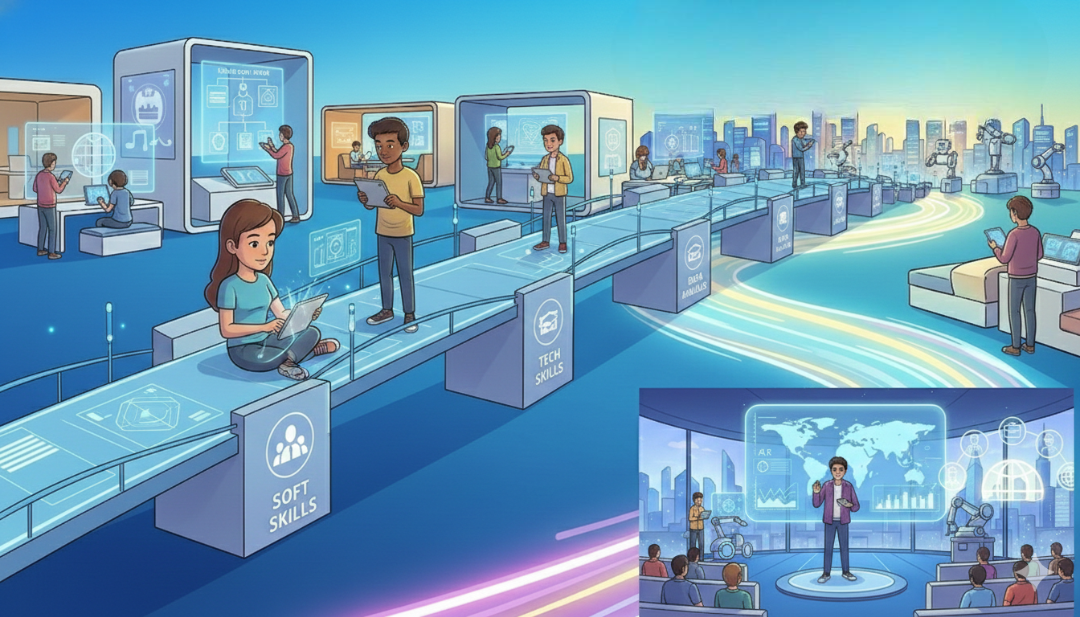
Generation Z’s Strategies for Building a Career in the Artificial Intelligence (AI) Era
By Dr. Abdul Wadud Nafis, LC., MEI
The rapid development of Artificial Intelligence (AI) technology has brought fundamental changes to various sectors of life, particularly the world of work. AI not only functions as a tool but has become a significant actor in production processes, decision-making, and even human resource management. This condition demands a significant transformation of competencies and work patterns.
Generation Z (Gen Z), as the generation born and raised in the digital era, has great potential to adapt to these changes. However, Gen Z’s familiarity with technology does not automatically guarantee career readiness in the AI era. Therefore, a comprehensive and sustainable strategy is needed so that Gen Z can build relevant, competitive, and resilient careers amid technological disruption.
1. Characteristics of the World of Work in the AI Era
The world of work in the AI era has several main characteristics that distinguish it from previous eras. First, the increased automation of routine and administrative tasks previously performed by humans. Second, the emergence of new technology-based professions, such as data analyst, AI trainer, digital marketer, and UX designer. Third, the increasingly open global job market through remote working systems.
These conditions demand a workforce that not only possesses technical expertise but is also capable of critical, creative, and adaptive thinking. In this context, Gen Z needs to understand changes in the world’s work structure to design appropriate and realistic career strategies.
2. Challenges for Generation Z in Building a Career
Although possessing advantages in digital literacy, Gen Z still faces various serious challenges in the AI era, including:
2.1. Increasingly Intense Global Competition
Digital technology allows companies to recruit workers from various countries. This increases competition, both in terms of workforce quality and cost.
2.2. Skill Gap
Not all Gen Z individuals have equal access to technology education and training. Consequently, a gap exists between industry needs and the competencies of the young workforce.
2.3. Long-Term Career Uncertainty
Rapid technological change causes many jobs to be temporary and vulnerable to replacement by AI, thus creating career uncertainty.
2.4. Psychological and Mental Pressure
The demands to always be productive, learn quickly, and compete globally can trigger stress, anxiety, and mental fatigue in Gen Z.
3. Generation Z’s Strategies for Building a Career in the AI Era
3.1 Mastering Digital Literacy and AI Basics
Mastery of digital literacy is the main foundation for a career in the AI era. Gen Z needs to understand the use of digital technology, data security, and the basic principles of AI. This understanding does not require everyone to become a programmer, but it should be sufficient to enable effective and ethical collaboration with AI systems.
3.2 Developing Relevant Technical Skills
Gen Z needs to focus on skills with high resilience to automation, such as data analysis, programming, digital design, and information system management. Skill selection should be tailored to interests, talents, and labor market needs.
3.3 Strengthening Soft Skills and Emotional Intelligence
Soft skills such as effective communication, teamwork, leadership, empathy, and conflict management become humans’ primary advantages over machines. AI can replace technical functions but cannot fully replace human values in social interactions and ethical decision-making.
3.4 Applying Lifelong Learning Principles
A career in the AI era demands a continuous learning process. Gen Z needs to get accustomed to following online training, seminars, professional certifications, and self-learning through various digital sources. A lifelong learning attitude becomes the key to maintaining competency relevance.
3.5 Building Personal Branding and a Positive Digital Footprint
Personal branding is an important aspect in the modern world of work. Gen Z needs to utilize social media and professional platforms to positively showcase competencies, work, and ideas. A good digital footprint can increase trust and open up broader career opportunities.
3.6 Being Adaptive and Flexible Towards Change
Gen Z needs to realize that careers in the AI era are not always linear. Shifts in fields of work, flexible work systems, and cross-disciplinary collaboration are becoming common. An adaptive attitude and openness to change will help Gen Z survive and thrive amid uncertainty.
3.7 Upholding Ethics, Values, and Professional Integrity
The use of AI must be accompanied by ethical awareness. Gen Z must uphold values of honesty, responsibility, and integrity in technology use. Professional ethics form an important foundation so that technological progress remains aligned with humanity.
4. The Role of Education and Social Environment
The success of Gen Z’s career strategies is not only determined by the individual but also by the education system, family, and social environment. Educational institutions need to align curricula with the needs of the AI era, while families and communities play a role in instilling character values, work ethic, and independence.
5. Conclusion
The Artificial Intelligence era presents both significant challenges and opportunities for Generation Z. With the right strategy—encompassing mastery of technology, strengthening of soft skills, continuous learning, personal branding, adaptation to change, and a commitment to ethical values—Gen Z can build sustainable and meaningful careers. The future of the world of work is not determined solely by technological sophistication, but also by the quality of the humans who manage it.
Bibliography
Bakhshi, H., Downing, J. M., Osborne, M. A., & Schneider, P. (2017). The Future of Skills: Employment in 2030. London: Pearson & Nesta.
Brynjolfsson, E., & McAfee, A. (2014). The Second Machine Age: Work, Progress, and Prosperity in a Time of Brilliant Technologies. New York: W.W. Norton & Company.
Frey, C. B., & Osborne, M. A. (2017). The future of employment: How susceptible are jobs to computerisation? Technological Forecasting and Social Change, 114, 254–280.
International Labour Organization (ILO). (2019). Work for a Brighter Future: Global Commission on the Future of Work. Geneva: ILO.
McKinsey Global Institute. (2017). Jobs Lost, Jobs Gained: Workforce Transitions in a Time of Automation. New York: McKinsey & Company.
Organisation for Economic Co-operation and Development (OECD). (2019). OECD Skills Outlook 2019: Thriving in a Digital World. Paris: OECD Publishing.
Prensky, M. (2001). Digital natives, digital immigrants. On the Horizon, 9(5), 1–6.
Schwab, K. (2016). The Fourth Industrial Revolution. Geneva: World Economic Forum.
Susskind, R., & Susskind, D. (2015). The Future of the Professions: How Technology Will Transform the Work of Human Experts. Oxford: Oxford University Press.
World Economic Forum. (2020). The Future of Jobs Report 2020. Geneva: World Economic Forum.
Yusuf, M., & Widodo, S. (2021). Tantangan dan peluang generasi Z dalam dunia kerja di era Revolusi Industri 4.0. Jurnal Ilmu Sosial dan Humaniora, 10(2), 155–168.
Zubaedi. (2019). Pendidikan Karakter dalam Perspektif Pendidikan Nasional. Jakarta: Kencana.